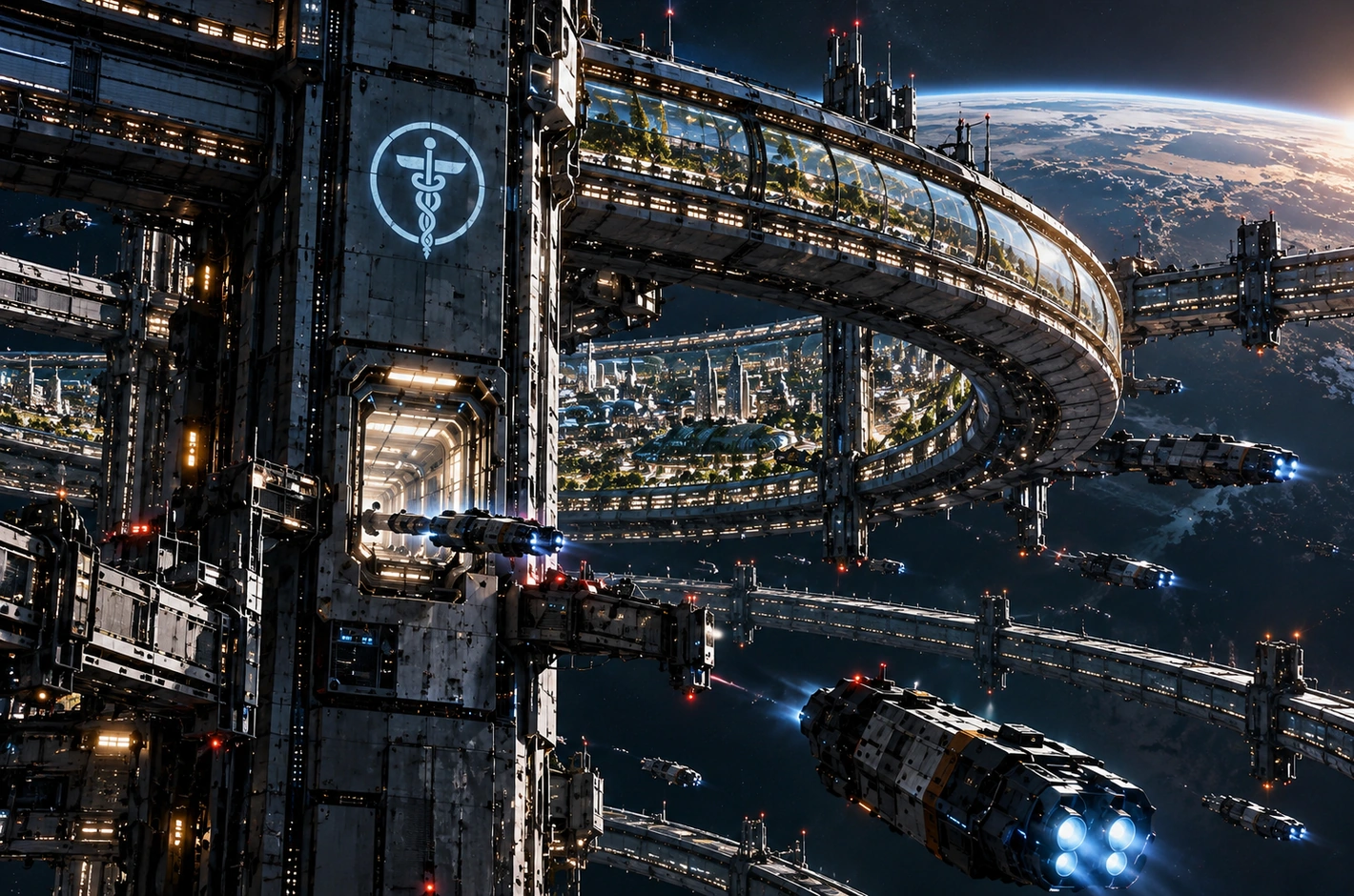
A colony is more than a place on a map.
In Mortal Stars, humanity lives in settlements, stations, and ships beyond a lost homeworld. These communities do not exist as isolated islands of abundance. Each depends on things it cannot produce alone, and the routes connecting them take time and resources.
For a reader interested in science fiction about space colonies, that dependence is central to the setting. A settlement’s future is shaped not only by where it is, but by what it needs, who can supply it, and what terms those suppliers can impose.
Building somewhere to live is therefore only the beginning. People also have to decide how to share resources, whom to trust, and who has the authority to act when priorities conflict. Distance does not make those questions disappear.
Travel takes time. So does an answer.
There is no faster-than-light travel in this fictional universe. Ships need fuel, a workable course, and time to reach a destination; messages do not outrun light. The rules of the setting keep those limits visible.
As a way of reading the story, those constraints turn distance into a source of responsibility. A crew cannot assume that help or new instructions will arrive exactly when needed. Supplies and maintenance matter because a difficult decision may have to be made with what is already aboard.
For the reader, this makes a journey more than a change of scenery. The distance between communities affects what people know, what they can promise, and how much they must decide for themselves.
Why a salvage crew is a way into this future.
The Nadir earns its living recovering what others leave behind. It is a working ship, not an invulnerable warship. Its crew depends on skill, patience, maintenance, and real supplies—the same practical concerns that connect it to the wider life of the colonies.
In The Ship That Never Was, that ordinary work leads to an extraordinary discovery. A vessel that should not exist challenges accepted history. Suddenly, deciding what can be proved becomes inseparable from deciding who has the power to keep that proof.
The crew gives the reader a close view of a much larger setting. The story can reach institutions, fleets, and political conflict without losing sight of the people who must keep a ship functioning through it all.
New worlds do not automatically mean equal futures.
The colonies share human origins, but they do not necessarily share loyalties or opportunities. Resources are uneven, institutions compete, and access to AION treatment is unequal. A longer life can depend on wealth and contracts rather than need alone.
That connection between material survival and political power drives the series beyond exploration. The Price of Life focuses on the systems controlling treatment. The Centenarians’ War brings divided colonies and fragile alliances into open conflict.
The resulting space opera is concerned with the cost of decisions as much as their scale. Supply lines, communities, and the people with the fewest choices matter alongside commanders and competing claims of authority. Read more about life extension and unequal access for the technology at the heart of that struggle.
What does home mean after Earth?
For people who have never seen it, Earth can be a place of inherited stories rather than personal memory. Its absence still shapes the colonies’ understanding of their past. A lost homeworld is therefore more than a destination: it is a question about what people have been taught to believe.
Earth, Volume IV, brings the search for the homeworld into focus. Routes must be checked and evidence tested, but finding answers also means confronting the difference between a place and the idea of that place.
The theme reaches back to life in the colonies. People can build new homes while carrying old uncertainties with them. Belonging involves trust, memory, and community as well as geography. This guide leaves the outcome of the search to the novel.
Where to begin reading.
Mortal Stars is a five-volume connected saga, not a set of standalone colony stories. Begin with The Ship That Never Was and follow the numbered reading order. A short opening extract is available on this site.
For a first look at the setting, open the spoiler-free universe guide. The colonies record in the interactive atlas offers a companion view. Choose No spoilers in the atlas if you have not read the books; the atlas may remember a reading level you previously selected.
This page describes the fictional setting of Mortal Stars, not a technical guide to real-world space settlement. It introduces the novels’ themes without revealing the resolution of their central mysteries.